Have you ever received a message that simply said “ION know” or “ION like that” and wondered what it actually meant? You’re not alone. Modern texting has created countless shortcuts, slang terms, and abbreviations that make conversations faster but sometimes more confusing.
The ION meaning in text has become increasingly popular across text messages, TikTok comments, Snapchat chats, Instagram DMs, Discord servers, and other social media platforms. While it may look like a scientific word related to chemistry, its meaning in texting is completely different.
Understanding today’s digital language helps you communicate more naturally and avoid misunderstandings. Whether you’re chatting with friends, browsing social media, or simply trying to keep up with internet slang, knowing what ION means can make online conversations much easier.
In this guide, you’ll learn what ION means in text, where it came from, when to use it, when to avoid it, and plenty of real-life examples. By the end, you’ll understand this popular slang with confidence. 🚀
What Does ION Mean in Text? 💬
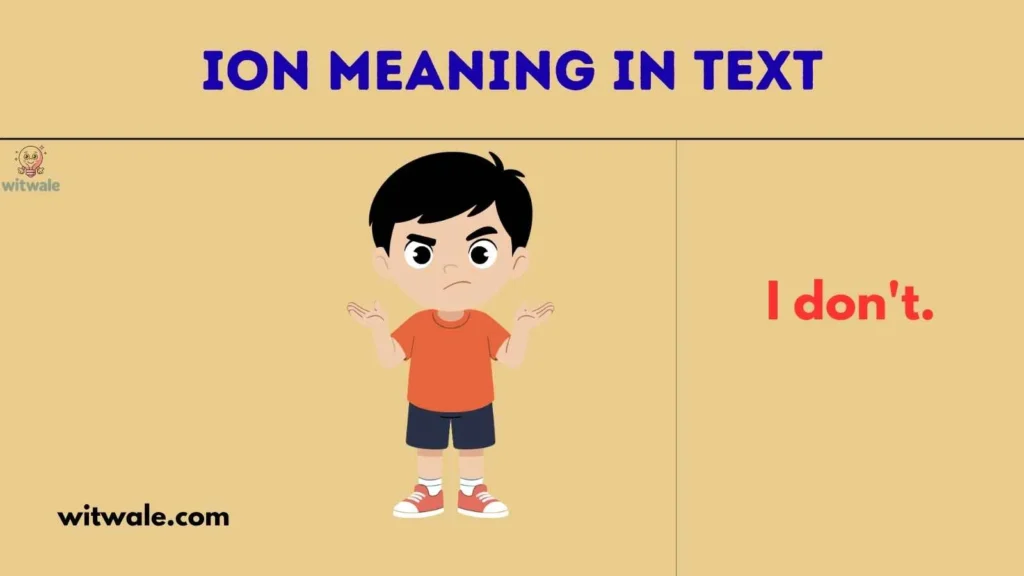
The ION meaning in text is usually:
I don’t.
Instead of typing I don’t, many people simply write ION because it’s quicker and matches casual speech.
Quick Answer
| Text | Meaning |
|---|---|
| ION know | I don’t know |
| ION care | I don’t care |
| ION think so | I don’t think so |
| ION want it | I don’t want it |
| ION remember | I don’t remember |
This slang is especially common among younger users who prefer fast, informal conversations.
Think of ION as a texting shortcut rather than an official abbreviation. It reflects how people naturally pronounce “I don’t” when speaking quickly.
Why Do People Say ION Instead of “I Don’t”? 🤔
Language constantly evolves, especially online. People love shortening words to type faster and sound more conversational.
Here are several reasons ION became popular:
- ⚡ Faster to type than “I don’t”
- 📱 Fits the casual style of texting
- 😂 Sounds natural in everyday speech
- 💬 Makes conversations feel relaxed
- 🚀 Common among Gen Z and younger Millennials
Many people pronounce “I don’t” so quickly that it sounds almost identical to “Ion.” Over time, this spoken pronunciation became a written slang expression.
For example:
Friend:
ION think that’s true.
Translation:
I don’t think that’s true.
The meaning stays exactly the same.
The Origin of ION in Texting 🌍
The internet has created thousands of new expressions, but ION developed differently from many common abbreviations.
Instead of being formed from the first letters of several words, ION came from spoken English.
When people casually say:
“I don’t know.”
It often sounds like:
“Ion know.”
That pronunciation eventually became part of online writing.
How It Evolved
- People spoke quickly.
- “I don’t” sounded like “Ion.”
- Friends copied the spelling in messages.
- Social media helped spread it.
- Today it’s common across many platforms.
Unlike formal abbreviations, ION represents pronunciation more than spelling.
Different Meanings of ION in Different Contexts 🔍
Although ION meaning in text usually means “I don’t,” context always matters.
Here are the most common meanings.
ION = I Don’t ✅
This is by far the most common usage.
Examples:
- ION believe him.
- ION have time.
- ION feel like going.
- ION remember that.
- ION agree.
ION = Scientific Ion ⚛️
Outside texting, an ion is a charged atom or molecule.
Example:
- Sodium forms a positive ion.
- Chloride is a negative ion.
This meaning belongs to chemistry and science—not texting.
ION as a Brand or Name 🏢
Sometimes ION refers to:
- Company names
- Shopping malls
- Technology products
- Hotels
- Buildings
Again, this depends entirely on context.
For texting conversations, “I don’t” remains the intended meaning almost every time.
How ION Is Used in Everyday Conversations 📱
The easiest way to understand the ION meaning in text is by seeing it used naturally.
Example 1
Alex:
Are you coming tonight?
Jordan:
ION think so.
Meaning:
I don’t think so.
Example 2
Emma:
Did you watch the game?
Ryan:
ION watch sports.
Meaning:
I don’t watch sports.
Example 3
Friend:
Do you know her?
You:
ION know her personally.
Meaning:
I don’t know her personally.
Example 4
Person A:
Want pizza?
Person B:
ION want food right now.
Meaning:
I don’t want food right now.
Example 5
Friend:
Can you help me tomorrow?
You:
ION have time tomorrow.
Meaning:
I don’t have time tomorrow.
These examples show that ION replaces only “I don’t.” Everything else in the sentence stays the same.
ION Meaning on Popular Social Media Platforms 📲
Although the definition stays the same, people use ION differently depending on the platform.
| Platform | Common Usage |
|---|---|
| TikTok | Funny comments and replies |
| Snapchat | Casual chats with friends |
| DMs and comment sections | |
| X (Twitter) | Short opinions and reactions |
| Informal conversations | |
| Discord | Gaming and community chats |
| Friendly personal messages | |
| Messenger | Everyday texting |
For example:
TikTok comment:
ION believe this actually happened 😂
Snapchat:
ION wanna wake up early 😭
Instagram DM:
ION think that’s a good idea.
The meaning remains consistent across all platforms.
When Should You Use ION? ✅
Although ION is widely understood, it’s best suited for informal communication.
You can safely use it when talking with:
- 😊 Friends
- 👨👩👧 Family
- 🎮 Gaming buddies
- 📱 Social media followers
- 💬 Group chats
- 😂 Meme communities
- 📸 Snapchat contacts
- 🎵 TikTok friends
Using ION helps conversations feel relaxed, modern, and natural.
However, remember that not everyone is familiar with internet slang. If you’re unsure whether the other person will understand it, writing “I don’t” is always the clearer choice
When Should You Avoid Using ION? 🚫
Although the ION meaning in text is widely recognized in casual conversations, it isn’t appropriate everywhere. Knowing when not to use it is just as important as knowing what it means.
Use full, professional language in situations where clarity matters.
Avoid using ION in:
- 💼 Job applications
- 📧 Business emails
- 🏫 School assignments
- 📄 Academic reports
- 📝 Legal documents
- 👨⚕️ Professional communication
- 🏦 Banking or financial messages
- 📑 Official government forms
Instead of writing:
❌ ION have the required documents.
Write:
✅ I don’t have the required documents.
Using complete sentences creates a more professional impression and avoids confusion.
Common Examples of ION in Text Messages 💬
Below are real-world examples showing how people naturally use ION in everyday conversations.
| Text Message | Meaning |
|---|---|
| ION know | I don’t know |
| ION care anymore | I don’t care anymore |
| ION wanna go | I don’t want to go |
| ION think that’s funny | I don’t think that’s funny |
| ION remember that day | I don’t remember that day |
| ION believe him | I don’t believe him |
| ION have money today | I don’t have money today |
| ION see the problem | I don’t see the problem |
| ION feel like studying | I don’t feel like studying |
| ION understand | I don’t understand |
These examples demonstrate that ION replaces only the words “I don’t.” The rest of the sentence stays unchanged.
ION Meaning on Snapchat 👻
Snapchat conversations are usually quick, casual, and full of slang. That’s why ION appears frequently in chats and streaks.
Common Snapchat examples include:
Friend:
Are you awake?
Reply:
ION sleep early.
Friend:
Do you know that guy?
Reply:
ION know him.
Friend:
Want to go out?
Reply:
ION feel like leaving today.
On Snapchat, users often skip punctuation and capitalization, making messages feel even more relaxed.
Examples:
- ion know 😂
- ion care lol
- ion think so
- ion wanna
- ion remember
Despite the lowercase spelling, the meaning remains exactly the same.
ION Meaning on TikTok 🎵
TikTok comments are known for creative slang, memes, and humor. ION is extremely popular because it saves characters while sounding conversational.
You’ll often see comments like:
- ION believe this 😂
- ION blame her honestly
- ION think anyone expected that
- ION even know what’s happening
- ION ready for this
Creators also use ION in captions to make their content sound more relatable.
Example caption:
ION know why this made me laugh so hard 😂
Because TikTok trends spread quickly, slang like ION often reaches millions of users in a short time.
ION Meaning on Instagram 📸
Instagram users frequently use ION in comments, Stories, Notes, and direct messages.
Examples include:
Friend:
Did you like the movie?
You:
ION think it was worth watching.
Comment:
ION expected this ending 😭
Story Reply:
ION miss summer already.
Instagram conversations are generally informal, making ION a natural fit.
ION Meaning on X (Twitter) 🐦
Short-form platforms encourage short words.
That’s one reason ION became so popular on X.
Examples:
- ION agree with this opinion.
- ION think that’s true.
- ION understand the hype.
- ION blame them.
- ION know what’s going on anymore.
Because character limits matter, replacing “I don’t” with “ION” helps users write shorter posts.
ION vs IDK vs IMO vs FR: What’s the Difference? 🔍
Internet slang can be confusing because many abbreviations appear in the same conversation. Here’s how ION compares with other popular texting terms.
| Slang | Meaning | Example |
|---|---|---|
| ION | I don’t | ION know |
| IDK | I don’t know | IDK what happened |
| IMO | In my opinion | IMO it’s great |
| FR | For real | That’s funny FR |
| TBH | To be honest | TBH I agree |
| SMH | Shaking my head | SMH that’s chaotic |
| BRB | Be right back | BRB dinner time |
| NGL | Not gonna lie | NGL that’s impressive |
Notice that ION is unique because it replaces only “I don’t.”
For example:
ION know ❌ equals I don’t know.
It does not mean:
- In our neighborhood
- International organization
- Instant online network
Context is everything.
Common Mistakes People Make About ION ⚠️
Many people misunderstand the ION meaning in text, especially when they see it for the first time.
Here are some common misconceptions.
Mistake 1: Thinking It’s the Science Word
Many assume the message refers to chemistry.
Example:
ION know.
This has nothing to do with charged particles.
It simply means:
I don’t know.
Mistake 2: Assuming It’s an Acronym
Unlike LOL or BRB, ION is not a traditional acronym.
Instead, it’s a written version of how many people naturally pronounce “I don’t.”
Mistake 3: Using It in Professional Writing
Writing:
ION attached the report.
can appear unprofessional.
Instead write:
I don’t have the report attached.
Professional communication should avoid informal slang.
Mistake 4: Using It With People Who Don’t Know Slang
Older family members, teachers, clients, or colleagues may not recognize ION.
Choosing the full phrase avoids unnecessary confusion.
Why Internet Slang Like ION Keeps Growing 📈
Language has always changed with technology. Every new platform introduces fresh ways to communicate.
People enjoy slang because it offers several benefits:
- ⚡ Faster typing
- 😊 Casual conversations
- 😂 Humorous expression
- 📱 Mobile-friendly communication
- 🎯 Shorter messages
- 🤝 Shared online culture
Terms like ION, IDK, IMO, SMH, and FR spread rapidly because millions of people use them every day.
As younger generations shape digital communication, new slang continues to appear while older expressions gradually fade away.
Learning these terms helps you stay connected with modern online conversations and understand the context behind what people are really saying.
FAQs
What does ION mean in text?
The ION meaning in text is usually “I don’t.” People use it as a casual shortcut in text messages and on social media.
Example:
ION know what happened.
Meaning:
I don’t know what happened.
Is ION an abbreviation?
Not exactly.
Unlike abbreviations such as LOL or BRB, ION is based on pronunciation rather than the first letters of words. It reflects how many people naturally say “I don’t” in fast, casual speech.
Is ION considered rude?
No. 😊
By itself, ION isn’t rude or disrespectful. It’s simply informal internet slang.
However, the overall sentence can sound polite or impolite depending on the wording.
Polite:
- ION think that’s the best idea.
Less polite:
- ION care.
Always consider your tone and the person you’re talking to.
Can I use ION in school or work?
It’s better not to.
Use “I don’t” instead of ION in:
- 📧 Professional emails
- 🏫 School assignments
- 📄 Reports
- 💼 Workplace communication
- 📝 Business documents
Formal writing should avoid internet slang whenever possible.
Is ION popular among Gen Z?
Yes! 🎉
Gen Z and younger Millennials frequently use ION in text messages, TikTok comments, Snapchat chats, Instagram DMs, and other casual online conversations because it’s quick and easy to type.
Quick Recap: ION Meaning in Text 📝
If you’re looking for a fast answer, here’s a simple summary.
| Question | Answer |
|---|---|
| What does ION mean? | I don’t |
| Is it formal? | ❌ No |
| Where is it used? | Texting and social media |
| Is it an acronym? | No, it’s based on pronunciation |
| Can it have other meanings? | Yes, in science it means a charged atom or molecule |
| Is it common? | ✅ Very common in casual chats |
Key Takeaways 💡
Before you leave, remember these important points about the ION meaning in text:
- ✅ ION almost always means “I don’t” in casual texting.
- ✅ It’s popular on TikTok, Snapchat, Instagram, WhatsApp, Discord, Messenger, and X.
- ✅ The slang comes from the way people naturally pronounce “I don’t.”
- ✅ Context is important because ion also has a scientific meaning.
- ✅ Use ION only in informal conversations with friends or family.
- ✅ Choose “I don’t” in professional, academic, or official communication.
- ✅ Understanding internet slang helps you communicate more confidently online.
Final Thoughts 🌟
The ION meaning in text is simple once you understand the context. In most online conversations, it stands for “I don’t,” making messages shorter, faster, and more conversational.
As texting culture continues to evolve, new slang terms appear almost every day. While you don’t need to use every trending expression, recognizing common ones like ION helps you follow conversations on social media and communicate more naturally with others.
Whether you see “ION know,” “ION care,” or “ION think so,” you’ll now know exactly what the sender means. Just remember that context matters, and using standard language is still the best choice for formal situations.

I’m a language and communication enthusiast who specializes in explaining word meanings, text abbreviations, slang terms, and internet expressions in a simple way. My goal is to help readers quickly understand the meanings behind everyday words and online conversations with clear, easy-to-read explanations.